After building websites and doing SEO for 40+ service businesses, I decided to start owning the assets I was building
The Idea Behind Aha Sites
I've spent the last 8 years building websites, running Google Ads, doing SEO, and consulting for 40+ service businesses.
Plumbers, tree companies, contractors, auto services, and other local businesses.
And somewhere along the way, I had an “aha” moment.
I'm pretty damn good at getting local service websites found.
I've learned how different service categories behave in Google Ads, what companies are willing to pay for leads, how bidding changes from one market to another, how much a water heater lead might be worth compared with a larger tree-removal or restoration job, and increasingly, how to get websites showing up not only in traditional Google SERPs but in AI search experiences like Gemini.
But there's something about the traditional agency model I've started to dislike.
You build a client a great website. You spend months improving their SEO. Rankings start moving. The website starts doing what you built it to do. And eventually, the amount of work required changes.
Sure, there are always optimizations, new content, new markets, conversion improvements, advertising, etc. But I realized I don't want to spend the next 10 years of my life constantly finding more client fulfillment work just so I can continue billing hours or retainers.
Why wasn't I building some of these assets for myself?
That became Aha Sites.
The concept isn't completely new. People in the SEO world will recognize elements of “rank and rent.” But I'm approaching it differently.
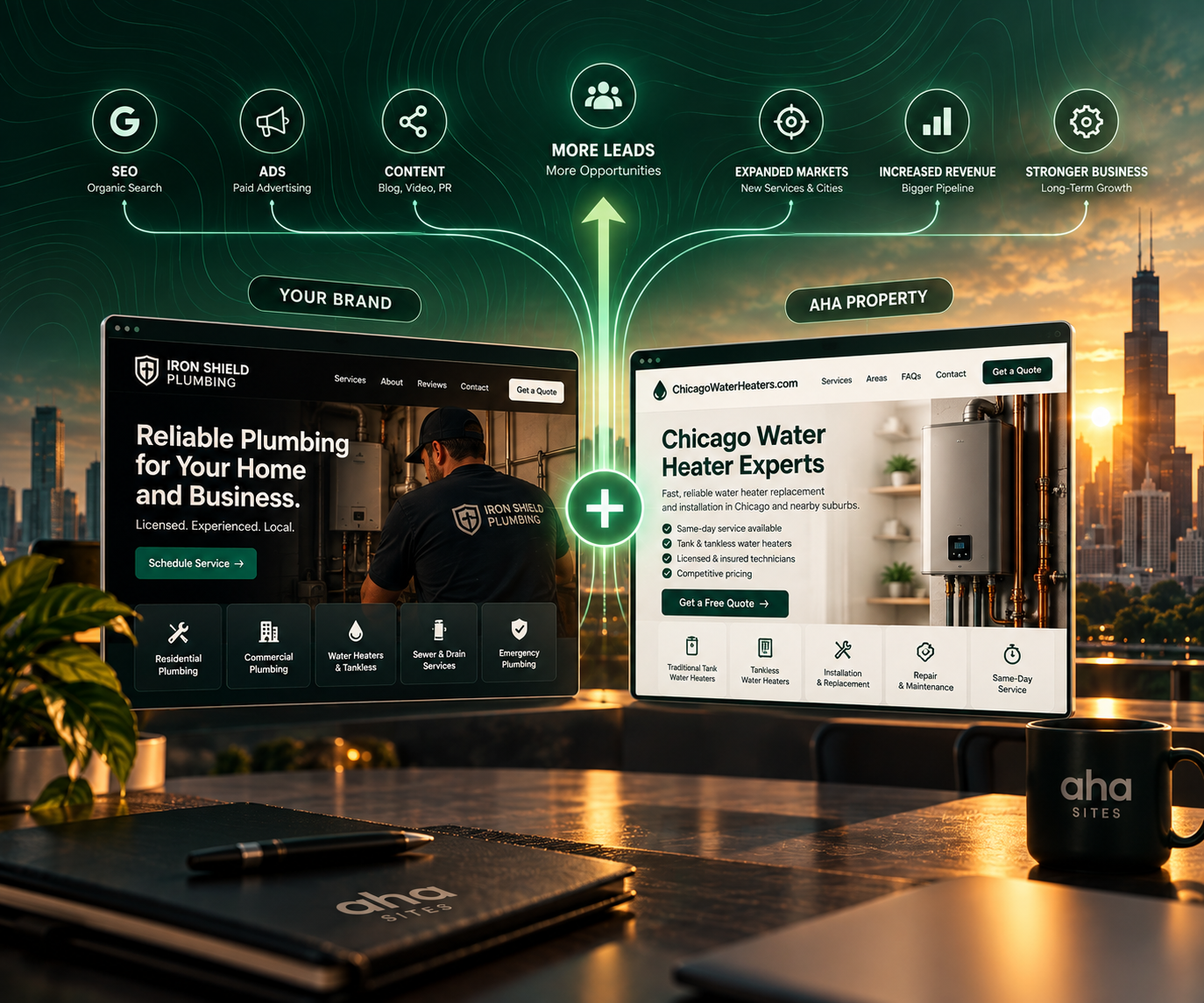
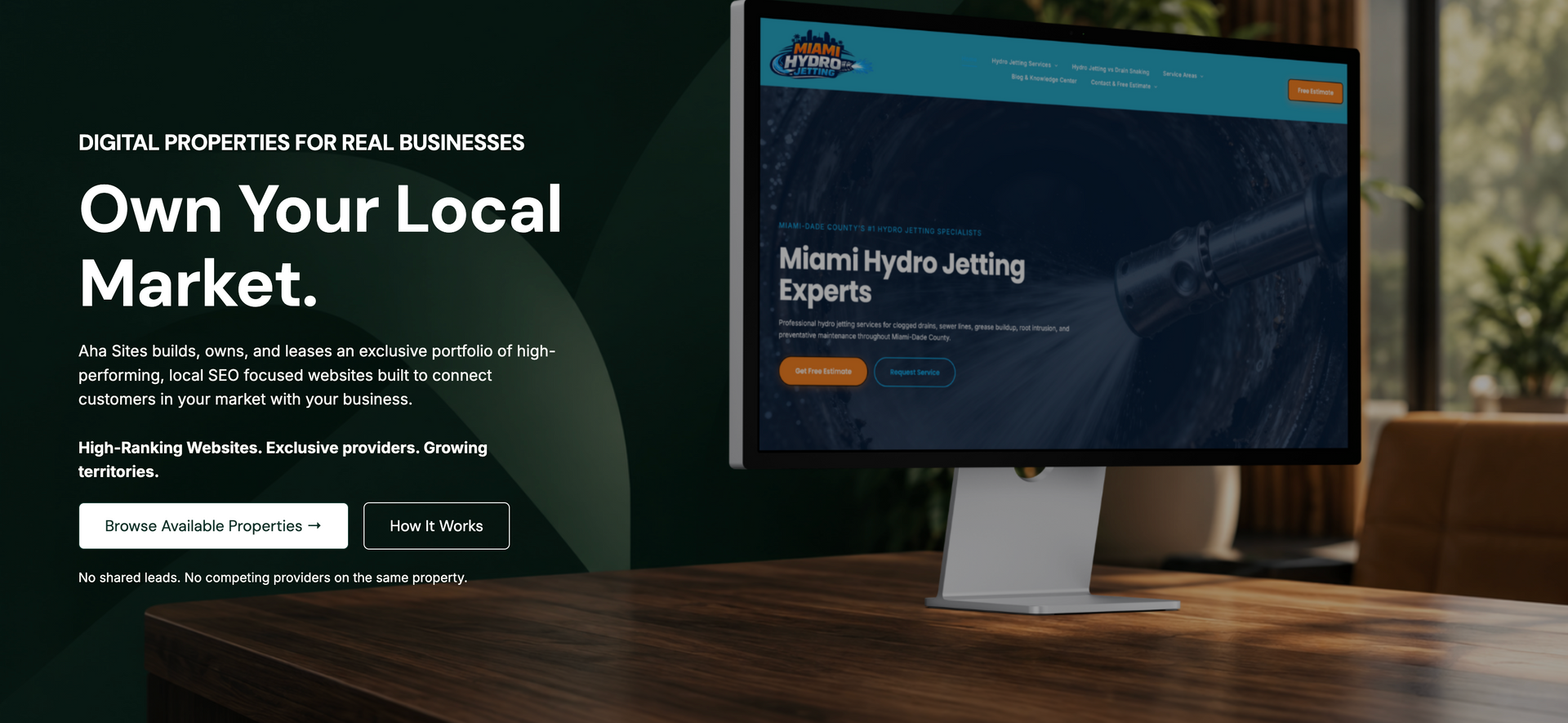
I've started building a portfolio of domains around specific services and geographic markets. Aha owns the digital property, develops it, builds its search presence, and makes that property available to an exclusive service provider in that market.
And rather than pretending every brand-new domain is immediately some incredibly valuable lead-generation asset, I'm trying to let the value of each property develop with the property.
A newer property might initially have a relatively small monthly lease/hosting cost while we're doing the groundwork. Then we measure what happens.
Does it rank?
Does it generate traffic?
Does it generate calls and forms?
What are those opportunities worth?
As a property develops actual traffic and lead-generation history, we can reevaluate what that digital property is worth at renewal.
That part of the model is really important to me.
I want the economics to be tied to the actual asset we're building.
So before really launching this, I decided to test the concept on my own dime.
I bought and developed GenevaWaterHeaterService.com, targeting water heater services in Geneva, Illinois. And it worked.
I was able to get the property ranking prominently in Google for targeted searches, including a #1 result I've documented, and I started seeing the site surface in Gemini/AI search results as well.
Then I wanted to know whether the same property could work as a paid acquisition asset.
I've managed Google Ads for service businesses before, so this wasn't my first time dealing with bidding, service-specific CPLs or local search campaigns.
I put roughly $500 of my own money aside to test paid acquisition on the property.
Early in the test, we generated a lead at roughly $20 CPA.
That's obviously one lead, not enough data for me to claim that I've discovered some magical $20-lead machine. But that's exactly why I'm testing these properties myself before making bigger claims about them.
And that's when the whole concept really clicked for me.
Instead of:
Client hires me → I build asset → I rank asset → client owns asset → I repeat forever
What if I build a portfolio?
Aha buys the property → Aha develops it → Aha gets it found → a service provider leases the market → Aha continues improving the asset.
Now we're taking it live.
I'm buying domains across different home-service categories and markets, but I don't want to blindly build 1,000 websites and hope someone wants them.
I want the service providers themselves to help determine where we go next. If a plumber comes to me and says: “I want Naperville, Geneva, St. Charles, Wheaton, and Batavia.” Great.
Let's look at those markets, the services you actually want, search behavior, advertising economics, the domains we already own, and what territories make sense to develop.
We're also building larger “market takeover” packages where a company can potentially secure multiple service-specific properties across a territory rather than leasing one website.
And eventually there is another layer to all of this.
Because I've spent years running advertising and working inside these businesses, I don't just want to dump a form submission into someone's email and call it a “lead.”
We're building optional tracking around the properties so eventually we can understand:
Traffic → Call/Form → Qualified Lead → Estimate → Closed Job → Revenue
That's where I think this gets really interesting.
If a property eventually generates $100,000 in attributable business for a service company, that's a fundamentally different asset from a domain I registered three weeks ago.
The value should reflect that, so yes, there's some rank-and-rent DNA here. But what I'm trying to build feels more like a portfolio of digital real estate for service businesses, where the properties are developed, leased exclusively, measured, advertised when appropriate, and valued according to what they actually become.
I'm pretty dialed in on this right now because it's combining basically everything I've learned from building sites, SEO, paid search, and consulting for service businesses, except now I'm building assets instead of only selling fulfillment.
We're at the point now where I'm looking for our first group of exclusive service providers, as well as companies that want to tell us what territories they would want developed specifically for them.
I'm curious what other people in home services, SEO, paid search, or lead gen think about the model.
If you owned a service company, would you rather have someone pitch you another SEO retainer, or have the opportunity to become the exclusive provider behind a digital property that's already being developed for the exact service and market you want?
Recent Posts