
Generating the Lead Was Never the Hardest Part
How Do We Track Lead-to-Revenue Attribution Through Aha Tracking?
A few years ago, through my marketing agency, I started working closely with a tree service company.
We didn't just run a few ads.
We went through what I would consider a pretty significant digital transformation.
Website. Search. Advertising. Lead generation. CRM. Follow-up. Tracking. Content. The pieces started coming together.
Eventually, there were days where we were seeing 2, 5, sometimes 10 new leads come through in a day.
That's an exciting problem to have.
But it exposed another problem that I would eventually see over and over again.
Generating demand and understanding what happened to that demand are two completely different things.
And as I started getting involved with larger service companies, this became increasingly obvious.
I've watched companies go through major digital transformations and, in some cases, double their revenue.
But here's the crazy part.
You could walk into a service business doing $10 million or $20 million a year and ask what sounds like a very simple question:
“Where did your new customers come from?”
And suddenly things got complicated.
Where did all the customers actually come from?
Let's say the marketing report says Google Ads generated 83 leads last month.
Great.
Where are they?
Which ones became customers?
Which ones booked estimates?
Which ones actually bought something?
How much revenue did they generate?
What was the gross value of those jobs?
Were they profitable after advertising and marketing costs?
And were all 83 actually new customers?
Now take the website.
How many people called the phone number on the website?
How many submitted a form?
How many called through the company's Google Business Profile?
How many of those callers were completely new customers versus existing customers calling back about previous work?
What happened after the phone rang?
Did somebody answer?
Did the customer schedule?
Did somebody follow up?
Did an estimate go out?
Was it accepted?
And eventually:
Did the marketing actually generate profitable new business?
Those are completely different questions from:
“How many leads did we generate?”
And I became increasingly frustrated by how difficult it could be to answer them.
The attribution gap
This isn't necessarily because anybody is doing something wrong.
It's partly a structural problem with traditional marketing.
The advertising company manages the ads.
The SEO company works on the website.
Someone else manages the CRM.
The office staff answers the phones.
Sales handles estimates.
Operations completes the work.
Accounting knows what actually got paid.
And everybody has their own system.
So whose responsibility is it to connect the entire thing?
That's where things get fuzzy.
The agency says:
“We generated the lead.”
The business says:
“Okay... but did that lead become a customer?”
Marketing might not know.
Sales might not know where the lead originally came from.
The CRM might list it as "website."
Google Ads reports a conversion.
Analytics reports another conversion.
The office says the phone has been ringing.
Revenue is increasing.
Everybody feels like something is working.
But nobody can clearly draw the line:
Marketing Investment → New Customer → Closed Job → Revenue
I got tired of that.
And it became another problem I wanted Aha to solve.
So we built Aha Tracking.
There's a fundamental difference between the Aha model and a traditional marketing engagement.
With Aha Sites, we own and operate the digital property generating the opportunity.
If someone discovers one of our properties, calls the dedicated number on that property or submits its form, we can establish a much cleaner starting point for attribution:
That opportunity originated from the Aha property.
Now we can start following what happens next.
That's where Aha Tracking comes in.
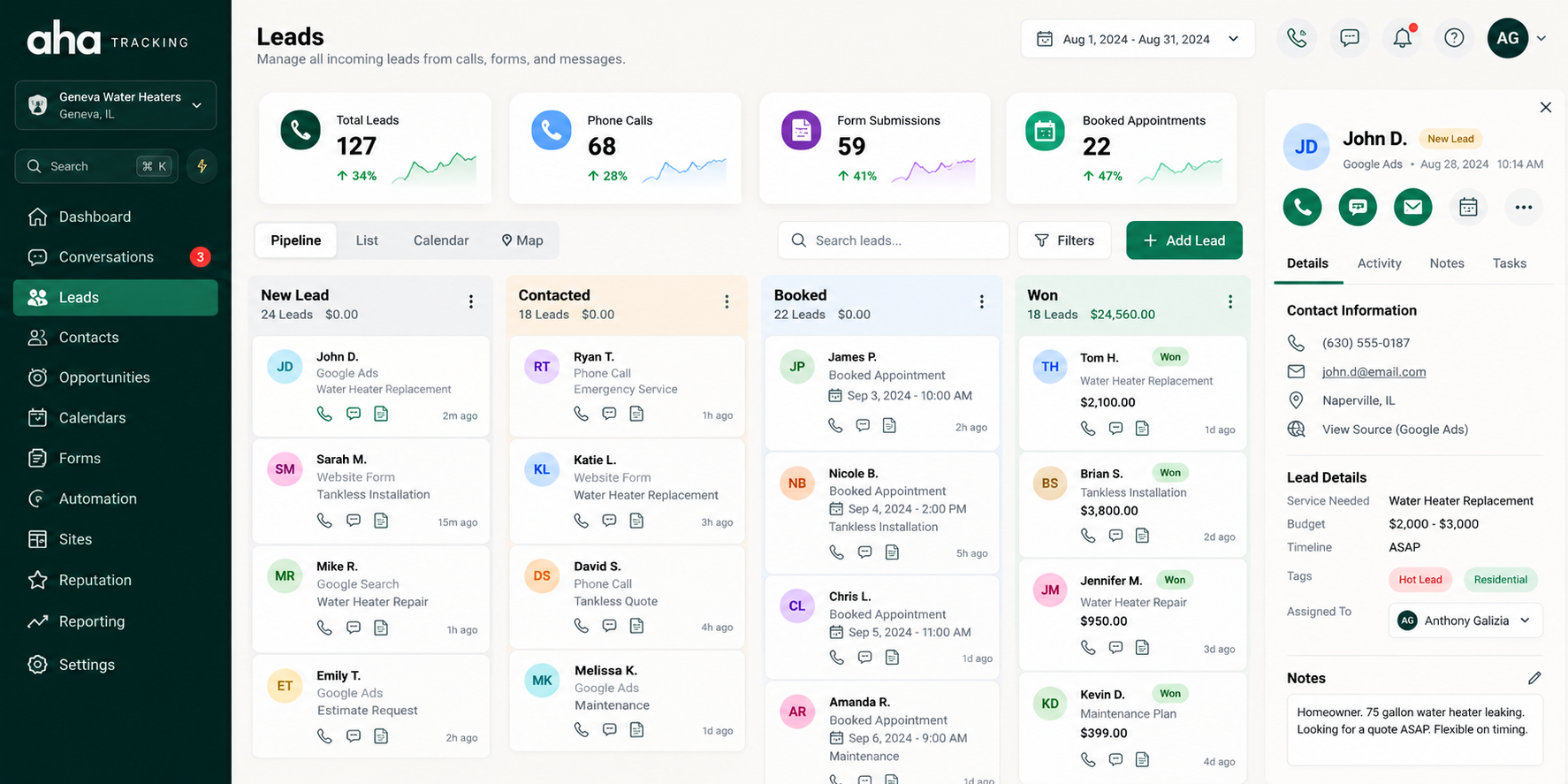
Aha Tracking is the optional customer-management, communication, and attribution layer we're building around our digital properties.
Instead of stopping at:
“Here's your lead. Good luck.”
We can build a system around what happens afterward.
Someone calls your Aha Site.
A dedicated tracking number can identify the property that generated the call.
Call activity can be recorded in the system.
Depending on the configuration and applicable consent requirements, calls can be recorded or transcribed for quality and attribution purposes.
The customer record can be created automatically.
The source can stay attached to that customer.
And the opportunity can begin moving through a pipeline.
Someone submits a form.
Same idea.
The inquiry doesn't have to disappear into someone's email inbox.
It can create or update a contact.
Notify the appropriate person.
Trigger an immediate response.
Create an opportunity.
Assign a follow-up task.
Send a text.
Send an email.
And begin tracking what happens next.
Now instead of simply knowing:
Aha generated 37 leads.
We can start working toward something much more valuable:
37 inquiries
31 qualified opportunities
24 estimates
15 closed customers
$48,000 in attributed revenue
Those numbers are just an example of how the reporting works, not Aha performance claims, but that's the level of visibility I'm interested in building.
Because 37 leads doesn't tell me whether your marketing worked.
Revenue gets us much closer.
Profitability gets us closer still.
And then there's the next problem: what happens when it REALLY works?
This is something I don't think people talk about enough.
Growth creates operational problems.
Everyone wants more leads when they're getting five a month.
Then suddenly they're getting 20.
Then 30.
Then 50.
Now somebody has to answer them.
Somebody has to follow up.
Somebody has to remember who asked for an estimate Tuesday.
Somebody has to follow up with the person who didn't answer.
Somebody has to know which customers need another service six months from now.
Somebody has to know which opportunities are still open.
And somebody eventually needs to answer:
“Did we actually make money?”
That's why I don't want Aha to simply become another lead company.
The lead is the beginning of the transaction, not the end of our responsibility.
This changes how we can expand into new markets, too.
One of my favorite parts of the Aha model is how we're approaching the value of the digital property itself.
Imagine you're a plumbing company and you want us to develop a new territory for you.
We acquire or develop a relevant property.
There's no meaningful traffic yet.
No lead history.
No demonstrated revenue.
I'm not interested in pretending that brand-new property is worth the same amount as an established Aha property generating consistent opportunities.
We want the value of the property to develop alongside the opportunity it creates.
That means a service provider can potentially get involved early at a relatively low initial lease cost while we put in the groundwork.
We develop the property.
We work on its search visibility.
We learn what the market responds to.
We can add advertising when appropriate.
We track what happens.
And as the property establishes real market value, its lease value can be reassessed at future renewal periods based on the opportunity it represents.
That gives the early service provider something I really like:
a head start.
You're not being asked to pay mature-property pricing for an asset that hasn't matured yet.
You're growing with it.
Now imagine doing that across an entire market.
This is where our Market Expansion packages start making a lot more sense.
Instead of acquiring one Aha property, a company might eventually operate across a portfolio:
Plumbing Property — Geneva
Water Heater Property — Geneva
Plumbing Property — St. Charles
Water Heater Property — St. Charles
Sewer Property — Batavia
Each one can have its own source tracking.
But all of the opportunities can feed into the same customer-management infrastructure.
One inbox.
One contact database.
One pipeline.
One automation system.
One attribution layer.
Suddenly handling 20–50 opportunities a month doesn't have to mean spreadsheets, missed calls, forgotten estimates, and five disconnected marketing dashboards.
The infrastructure is already there to help organize it.
And because Aha properties can begin at a lower cost while they're being developed, the business doesn't necessarily have to make an enormous upfront investment just to find out whether a new territory has potential.
Build the market.
Track the opportunity.
Manage the customer.
Measure the revenue.
Then decide where to invest more.
That's what I wanted Aha to solve.
I originally started Aha because I had spent years building digital assets for other businesses and eventually had the realization:
Why am I not building these assets for myself?
Then AI and modern web technology gave us the ability to research, develop, and manage those properties at a scale that would have been extremely difficult for a company our size just a few years ago.
But there was still one piece missing.
What happens after it works?
I've seen what happens when businesses suddenly start generating substantially more demand.
More leads don't automatically create a better business.
Sometimes they just create a bigger mess.
So if Aha is going to help create the opportunity, I want us to build the infrastructure that helps companies actually capture it, respond to it, understand it, and measure what it becomes.
Because at the end of the day, I don't want the conversation with an Aha customer to be:
“Look how many leads we generated.”
I want it to become:
“Here's where your customers came from. Here's what happened to them. Here's the revenue we can attribute to those opportunities. And here's where we should build next.”
That's Aha Tracking.
And for me, it solves one of the biggest problems I've encountered throughout my career in digital marketing:
Closing the gap between marketing activity and actual business growth.
Recent Posts