We’ve Been Building With AI Since the Beginning. Now It’s Changing What We Can Build.
How Aha is Possible Today.

AI Is Going to Consolidate Marketing. I Don't Think That's Necessarily a Bad Thing.
I recently had a conversation with a founder in the retail space whose company does around $50 million a year.
We were talking about marketing, technology, and where all of this is heading, and he said something that stuck with me:
AI is going to consolidate marketing.
And in a lot of ways, I think he's right.
We're going to watch things that once required several different people, platforms, agencies, and workflows become increasingly connected.
Research. Data analysis. SEO. Content architecture. Website development. Advertising. Reporting. AI is going to touch all of it.
The knee-jerk reaction is to assume that's a bad thing.
I don't necessarily think it is.
It depends entirely on what we decide to replace with AI, and what we don't.
At Aha, We Are Anti-AI slop.
I've been working with AI since ChatGPT first became publicly available, and ironically, the more I've used it, the more opinionated I've become about where I don't want it.
I don't want every company's social media filled with obviously AI-generated graphics.
I don't want a local business replacing photographs of its actual people with fake employees who don't exist.
I don't want every company video to feature some synthetic spokesperson standing in an imaginary office.
And when I need customer service, I'd still rather talk to an actual person than fight my way through an AI agent pretending to understand why I'm annoyed.
There are places where real matters.
Real people.
Real photography.
Real video.
Real customer interactions.
Real projects.
Real expertise.
Real branding.
AI should help a company communicate those things, not replace them with synthetic versions because it's cheaper.
But behind the scenes?
That's where I think AI changes everything.
And that's a huge part of what we're building with Aha Sites.
When ChatGPT became publicly available, I was one of those people who immediately realized this wasn't just another piece of software.
I started using it. A lot...
Not because I thought AI was going to magically build businesses or replace the work I had spent years learning how to do. I was interested in something else:
What happens when someone who already understands websites, SEO, advertising, and local markets gets access to technology that can dramatically accelerate the work?
We've been experimenting with that question ever since.
And Aha Sites is probably the best example yet of where I think this is all heading.
AI Didn't Replace What We Know. It Made It Scalable.
Before Aha, I've worked with, consulted for, and built websites for more than 40 service businesses. That experience matters.
AI doesn't inherently know which services actually make money for a plumbing company. It doesn't know which pages I'd prioritize in a competitive local market. It doesn't automatically understand whether a keyword represents someone researching a problem or someone ready to spend thousands of dollars fixing one.
Those are things you learn from actually doing the work.
What has changed is how quickly we can turn that knowledge into infrastructure.
We're now developing workflows that use multiple AI systems at different stages of the process.
We can research a market.
Analyze competitors.
Evaluate search opportunities.
Organize keyword and SEO data.
Research services and customer intent.
Identify potential content gaps.
Develop site architecture.
Build structured instructions and prompts around what we've learned.
And then feed that information into the Aha Sites Web Builder Platform, where we can rapidly turn that research into an actual digital property.
The underlying platform we're building Aha on now supports AI-assisted generation of entire sites, individual pages and sections, while also supporting contextual content generation, metadata, image alt text, and programmatic site creation through APIs.
That's a massive change from how I was building websites just a few years ago.
We're Building a Website Factory. Not an AI Content Factory.
There's an important distinction here.
Our goal isn't to push a button and publish 10,000 garbage AI websites.
I think the internet has enough of those.
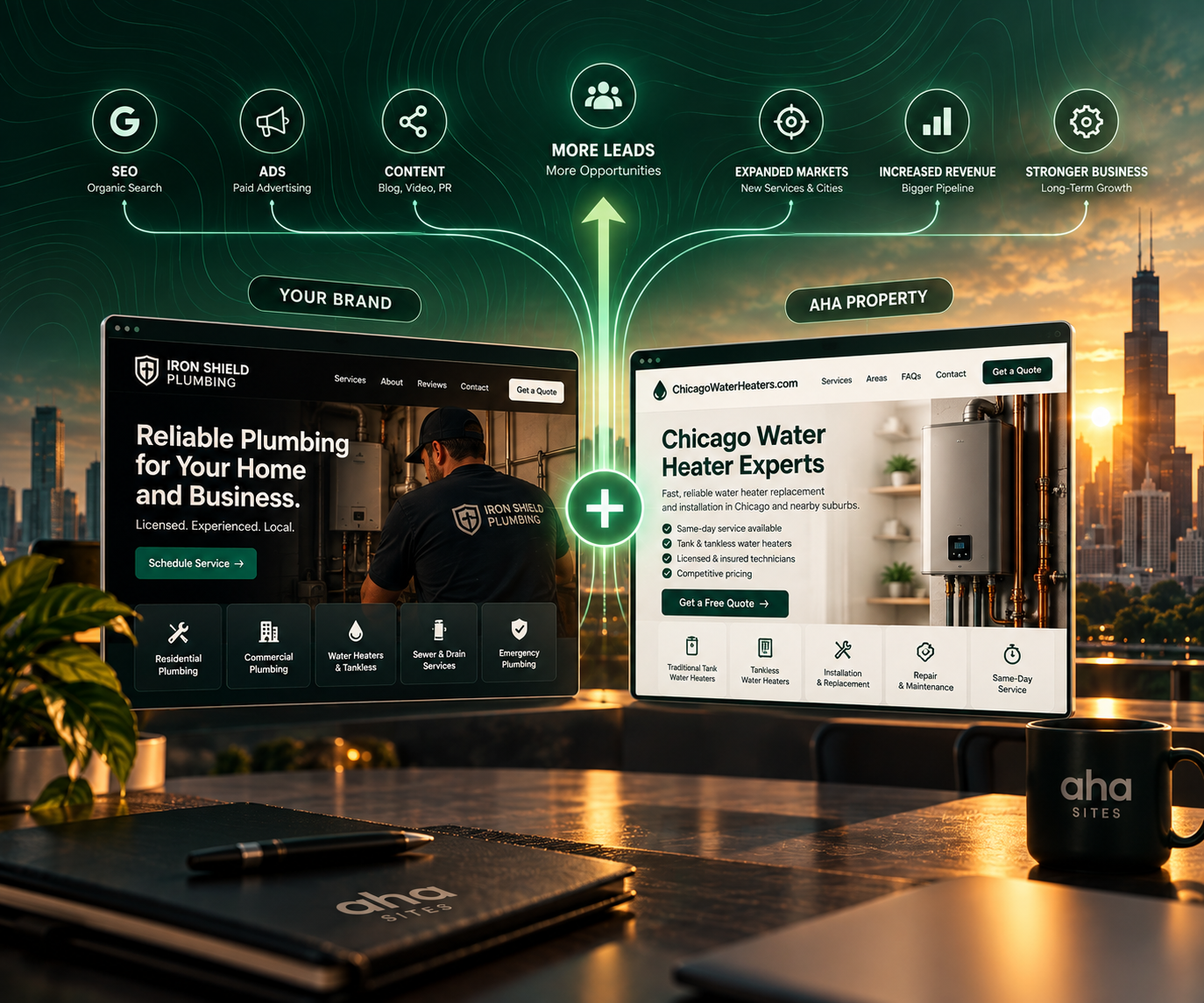
The opportunity I see is combining human strategy + real market data + AI research + structured workflows + professional web infrastructure.
Think about a plumber who comes to Aha and says:
“I want to grow water heater replacement in these six Chicago suburbs.”
Historically, developing six individual digital properties properly could require an enormous amount of repetitive work.
With the system we're developing, we can approach that completely differently.
Research the six markets simultaneously.
Compare search behavior.
Identify the services worth targeting.
Analyze competing websites and SERPs.
Develop the appropriate site architecture.
Build structured prompts based on that research.
Deploy the foundation through our web platform.
Then have a human actually review, edit, optimize and maintain what gets published.
AI accelerates the process. It doesn't eliminate the process.
And that's what has me so excited.
Things That Used to Take Weeks Can Start Happening in Days.
We're reaching a point where the limiting factor isn't necessarily how quickly someone can physically drag sections onto a website anymore.
The limiting factor becomes:
Can you identify the right opportunity?
Can you structure the right information?
Can you build the right strategy?
Can you evaluate what the machines produce?
And can you actually get the finished property to perform?
That's a completely different skill set.
Our web infrastructure is increasingly built for this kind of workflow. Sites can be created programmatically from structured business information, design requirements, and custom instructions, while reusable components, centralized content, and global design systems make maintaining a portfolio substantially different from manually maintaining dozens of disconnected websites.
That's particularly important for Aha because we're not trying to build one website.
We're building a portfolio of digital properties.
If we eventually operate hundreds or thousands of properties across different services, cities, and industries, we need technology that allows us to manage that portfolio intelligently.
That's where AI starts becoming much more interesting to me than simply asking ChatGPT or Claude to write a blog post.
And We're Still Early.
What's crazy is that the technology keeps moving.
The platform underneath Aha now supports conversational AI that can create and modify pages, update content and collections, and even generate custom website functionality. There are also integrations designed to let external AI tools interact with the web platform.
So we're experimenting.
We're figuring out which AI platform is best for which job.
One may be better for research.
Another may help us analyze large amounts of information.
Another may help structure a content architecture.
Another can help us turn all of that information into structured instructions.
And our web platform becomes the production environment where that work becomes an actual property.
The goal isn't AI-generated websites.
The goal is:
AI-assisted digital property development.
And I think we're only beginning to understand what's possible.
And for you nerds out there like me...
If you're the person who read all of that and thought:
“Yeah, yeah, AI is cool. But what is actually underneath these websites?”
This part is for you.
Because this is one of my favorite parts of what we're building.
The Aha Sites Web Builder Platform isn't some server sitting underneath my desk that I'm praying doesn't catch fire.
The underlying website infrastructure runs on Amazon Web Services (AWS) and includes cloud hosting, automatic backups, DDoS mitigation, encryption, and access controls.
Every published property receives SSL protection without us having to go buy and manually maintain certificates for every domain. The infrastructure supports HTTPS/TLS encryption in transit and AES-256 protection for data at rest.
There is also a global CDN for static assets, responsive delivery across devices, automatic PageSpeed optimization and site backups that allow previous versions to be restored.
And this gets even more interesting from an SEO perspective.
The platform handles a lot of technical infrastructure that we'd otherwise have to repeatedly engineer ourselves, including server-side rendering, canonical tags, redirects, predictable HTML structure, SSL and other search-friendly fundamentals.
The security layer isn't something we're duct-taping together with 17 WordPress plugins either.
The underlying platform has completed a SOC 2 Type II examination and is ISO/IEC 27001:2022 certified, while incorporating automated vulnerability scanning, continuous patching and penetration testing into its security program.
And that's where this starts getting kind of ridiculous in a good way.
A few years ago, if I told you I wanted to:
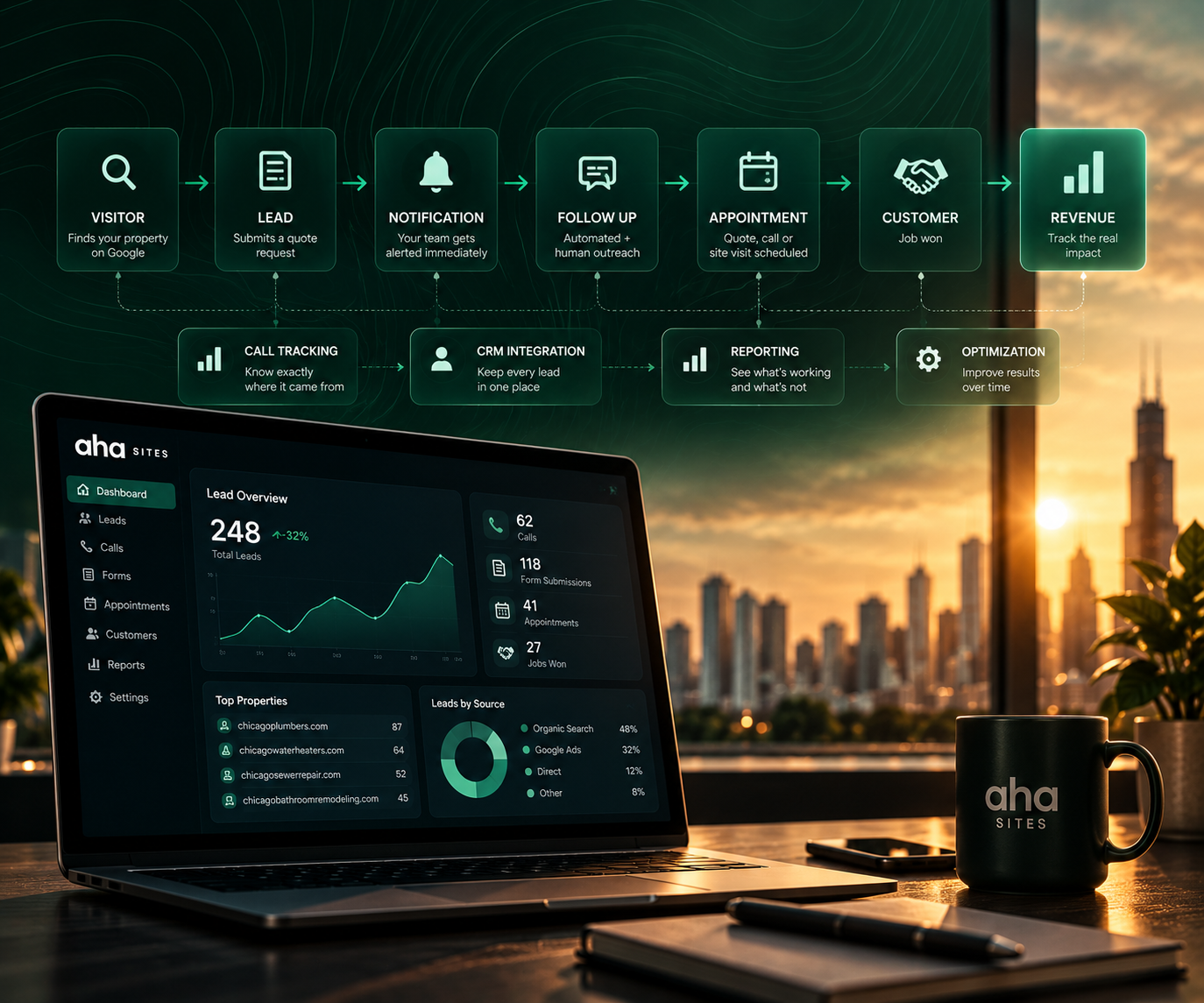
Research 50 local markets → analyze the search opportunity → develop individual site architectures → generate the initial infrastructure → deploy them onto AWS-backed hosting → automatically provision SSL → distribute assets through a CDN → centrally manage the sites → optimize them → track their performance → continuously improve the portfolio...
...I would have needed either a substantial development team or a concerning amount of caffeine.
Now?
We're building the workflows to actually do it.
And that's the part of AI that gets me excited.
It isn't that the computer suddenly knows more about my business than I do.
It's that technology is removing barriers between an idea and our ability to actually build it.
Things I would have considered impractical for a company our size only a few years ago are becoming possible.
And Aha Sites is our attempt to find out just how far we can take that.
Recent Posts